
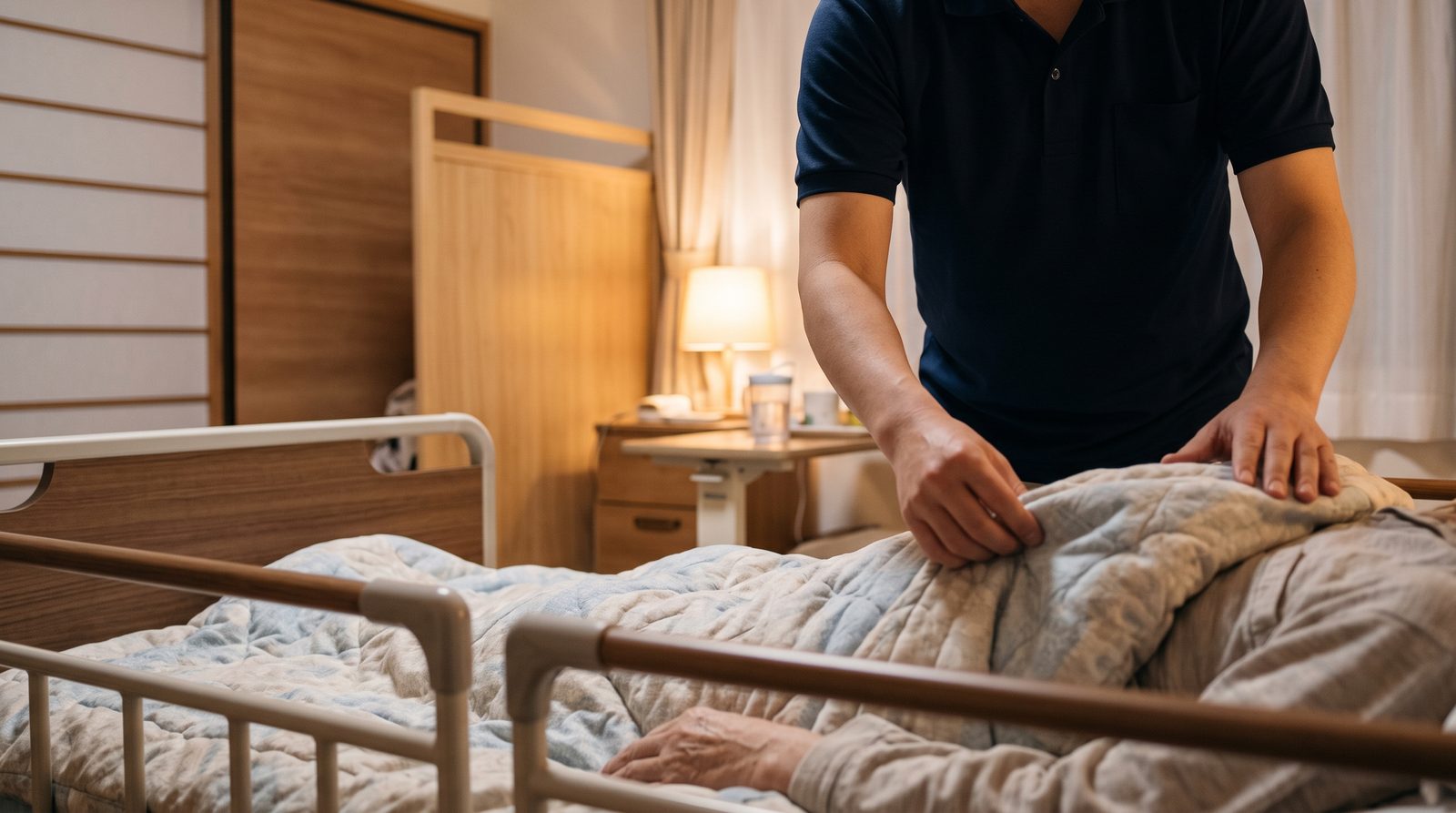
When looking for a long-term care facility or residential care service, many people prioritize “the cleanliness of the rooms,” “the atmosphere among the staff,” and “the monthly cost.” Of course, these are important factors that directly impact daily life.
However, the biggest concern families face after their loved one moves into a facility is how to handle sudden changes in their condition—questions like, “What if they suddenly develop a fever in the middle of the night?” or “If they suddenly feel unwell, who will take care of them and what will they do?”
Actually, depending on the facility, this"Medical Backup System"There is a significant difference between them. In this article, we’ll clearly explain the key points to check regarding a facility’s “medical care system”—information you’ll definitely want to review before entrusting your loved ones to their care.
1. What You Need to Know About the Line Between “Long-Term Care” and “Medical Care”
First and foremost, it’s important to understand that,"A long-term care facility is not a hospital (a place for treatment), but a place to live."That is to say.
For this reason, doctors are not on duty 24 hours a day at typical long-term care facilities (such as special nursing homes and group homes). In fact, it is not uncommon for facilities to have nurses on duty only during the day.
In other words, if a patient’s condition suddenly deteriorates at night or on a holiday, it is the “care staff” who will be on site. Since care staff are not authorized to perform medical procedures, the standard procedure is to seek instructions from an outside physician, call an ambulance, or contact the family to have the patient taken to the hospital.
2. “Three Questions” You Should Always Ask During a Facility Tour
So, what should you look for during a facility tour or consultation to determine whether it’s a place you can trust? Try asking the facility staff the following three questions.
Question 1: “What should I do if I develop a fever at night?”
Whether the response is, “I’ll call an ambulance,” or “First, I’ll contact the family and have them take the patient to the hospital,” or whether it’s, “I’ll immediately contact the on-call nurse or a collaborating physician and seek their instructions,” makes a huge difference in how quickly the initial response is handled.
Question 2: “Which medical institutions do you partner with (affiliated hospitals)?”
Every facility has designated “partner medical institutions.” However, what matters is not the “name” but the “distance and relationship.” Be sure to check: “Is that hospital close to the facility?” and “Is it a hospital that keeps track of the residents’ conditions on a regular basis?” If a resident is transported by ambulance to a hospital that is unfamiliar with their day-to-day condition, staff there will have to start from scratch in explaining the resident’s pre-existing conditions and medical history, which carries the risk of delaying appropriate treatment.
Question 3: “If I need to see a doctor or be hospitalized, is it mandatory for a family member to accompany me?”
Actually, this is what places the greatest burden on families. It’s not uncommon for facilities to have a rule stating, “In the event of a sudden change in the resident’s condition, family members must rush to the facility—even in the middle of the night or while at work—and accompany the resident to the hospital.” It’s essential to clarify exactly how much support the facility will provide and at what point family members are expected to step in.
3. “The greatest peace of mind” comes from having a doctor who knows your day-to-day condition examine you right away.
For older adults and people with disabilities, health problems can begin with even the slightest signs—such as difficulty swallowing food or slightly shallow breathing.
Instead of panicking and calling an ambulance after a sudden change in condition,An environment where you can immediately consult with doctors and nurses who are familiar with your daily life when you notice even a small change and think, “Something seems a little off.”...This provides the greatest peace of mind for both the individual and their family.
"The Connection Between Healthcare and Welfare" Provided by the Taiseikai and Kunikai Group
So far, I’ve been discussing the general medical care systems in facilities, but to conclude, I’d like to briefly touch on the initiatives of our Daiseikai and Kunikai Group.
One of the key features of the welfare services we provide at the Kuni Association (such as short-term stays and residential care) is,The fact that there is a medical facility called “Uchida Hospital” within the groupIt is.
If you notice any changes at a Kunikai facility—such as “a slight fever” or “behavior that’s different from usual”—We will work in collaboration with the doctors and medical staff at Uchida Hospital to address the situation. Because we not only have a formal relationship as “partner medical institutions” but also share information on a daily basis as part of the same group, we can ensure a seamless transition between medical and welfare services when a patient becomes ill or needs to be hospitalized.
To help ease—even just a little—the burden on family members who have to frantically search for a hospital in the middle of the night or take time off work to accompany a loved one, we support each person in living a life true to themselves by addressing both their welfare (daily living) and medical care (treatment).
If you have concerns about medical care while living in a facility, please take a closer look at this “collaboration between medical and social welfare services.”
\ Please feel free to contact us if you have any problems /.
Medical Corporation Daiseikai, Uchida Hospital, Community Healthcare Coordination Office
(TEL) 0278-24-5329
Uchida Home Care Support Office
(TEL) 0278-23-7535
▶ Click here for the Daiseikai Group Uchida Hospital Outpatient Schedule