
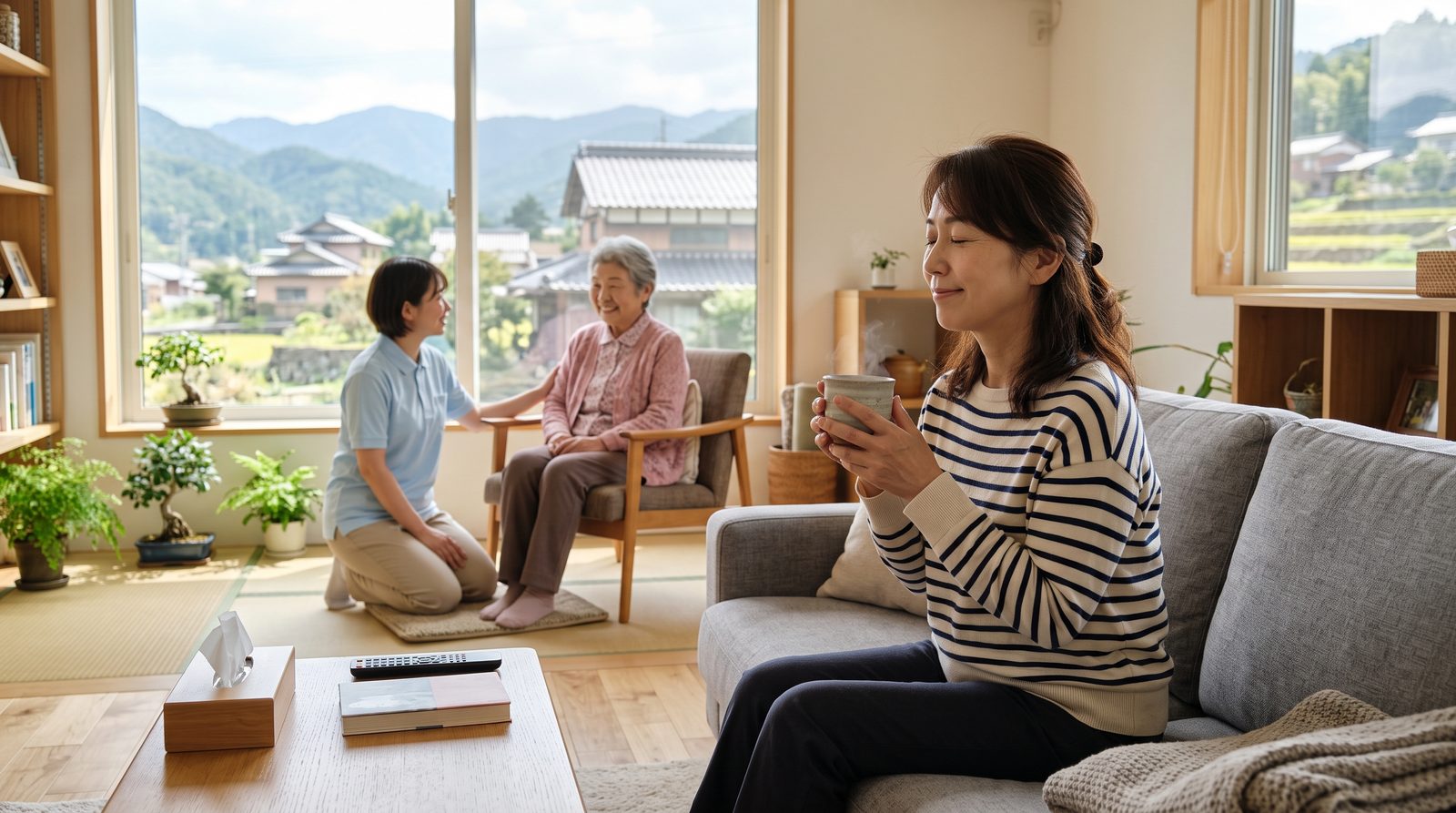
"Taking care of my parents has been a bit tough lately..."
"Will we be able to keep providing care just as a family?"
When you first start caring for a parent, there are often many things you can do, and many people probably feel, “We want to provide as much support as we can on our own.” However, as the caregiving period drags on, or as your parent’s physical condition or symptoms of dementia change, the burden on the family gradually increases. Continuing to provide care while juggling work, raising children, and your own life is by no means easy.
If you find yourself thinking, “Caregiving is too hard,” don’t just keep struggling on your own as a family—using caregiving services is also an important option.
In this article, we’ll introduce the different types of caregiving services and ways to help family members continue living at home while reducing their burden—for those who are feeling overwhelmed by caring for an elderly parent.
1. When do you find caring for your parents “exhausting”?
The burden of caregiving isn't just physical. For example, when factors like the following accumulate, the burden on family members becomes much greater.
- They began to need assistance with meals, changing clothes, bathing, and other activities
- There has been an increase in assistance with using the restroom and toileting
- It has become difficult to cope with memory loss and behavioral changes caused by dementia.
- I can't sleep well because I have to watch over them at night
- I've been accompanying people to the hospital more often
- I've been taking more time off work to provide care
- The burden of caregiving within the family falls disproportionately on one person
- I haven't been able to have any time to myself
- I started to feel that “providing care is hard”
If you find yourself in this situation, instead of trying to handle it all on your own as a family,Try reevaluating your caregiving methodsI recommend it.
2. “Family-provided care” is not the only form of care
When a parent needs care, some people may feel that “the family must provide as much care as possible.” However, long-term care insurance offers a variety of services designed to support the person’s daily life while reducing the burden on family members.
- Living at home while having a caregiver come to my home
- Attends day care during the day
- Use short-term stays only when necessary
- Combining Day Programs, Overnight Stays, and Home Visits
You can use these services to suit the individual’s condition and your family’s lifestyle, among other considerations.
Care services are not intended to replace family members as caregivers.A system that allows families to receive support from professionals for tasks that are difficult to handle on their own, enabling them to continue providing care without undue strainBut there is also.
3. Key Caregiving Services That Can Reduce the Burden on Families
Day Care and Outpatient Rehabilitation
Participants attend the facility during the day to receive services such as meals, bathing, and rehabilitation. For the participants themselves, this helps maintain their physical functioning and provides opportunities to interact with others, while for their families, it offers the benefit of being able to use that time for work, household chores, or personal rest. It also helps reduce situations where family members feel they must provide constant supervision throughout the day.
home nursing care
A caregiver visits your home to provide personal care—such as assistance with meals, bathing, and toileting—as well as daily living support, including cooking, laundry, and housekeeping. You may want to consider this service if you’d like to continue living at home but find it difficult to manage on your own with just your family.
short stay
This is a service that allows you to stay at a facility for a short period of time while receiving care and daily living support.This service is available not only when family members are temporarily unable to provide care due to work, travel, or special occasions such as weddings and funerals, but also to give family caregivers a chance to rest.
Some people may feel guilty about taking a break from caregiving. However,In order to provide long-term care, it’s important for family caregivers to take breaks as well.It is.
Small-Scale Multifunctional In-Home Care
This service centers on “day care” and allows users to combine it with “overnight stays” and “home visits.” Because it can be used flexibly depending on the individual’s condition and the family’s circumstances, it offers an option for those who wish to continue living in the home they’re accustomed to. At Daiseikai’s “Iyashiro Small-Scale Multifunctional Home,” we also provide support that combines day care, overnight stays, and home visits.
4. There isn't just "one" type of long-term care service
When using long-term care services, it is important to,Don't try to solve everything with a single serviceFor example, you can combine multiple services as follows.
- Weekdays → Day Services
- Bathing at home → In-home care
- Days when family members have unavoidable commitments → Short-term stay
In addition, as a parent’s condition changes, the services they need will also change. Someone who “only needs day care for now” may require in-home care or short-term stays a few years down the road. It’s important to reassess the approach to care based on the circumstances at any given time.
5. Even if you think, “I’m not ready to move into a facility yet,” it’s okay to seek advice.
Some people may think, “I don’t need to move into a facility yet, so there’s no need to seek advice just yet.” However, there are various options for long-term care services besides moving into a facility.
- Using the service while living at home
- Staying at the facility only when necessary
- Continuing to live at home while undergoing rehabilitation
We can explore ways to support daily life tailored to the individual’s condition and preferences.It’s perfectly fine to reach out for advice even if you’re still at the stage of wondering, “What services can I use given my current situation?”
6. You can consult your care manager about any concerns regarding caregiving.
"I know I should use a service, but I don't know which one to choose." In that case,Why not talk to your care manager?The following is a list of the most common problems with the
Care managers determine a plan by combining the necessary care services while taking into account the individual’s physical condition, living environment, and the family’s wishes, among other factors.Care PlanWe will create [the plan]. We will also handle communication and coordination with care service providers, medical institutions, and others.
At Daiseikai’s “Uchida Home Care Support Office,” you can seek consultation even if you are still in the early stages of considering the use of long-term care insurance. We provide consultation on long-term care, assist with applications for long-term care certification, help create care plans, and coordinate with service providers.
7. For Those in Numata City and Tone-Numata Who Wish to Consult About Long-Term Care
Taiseikai provides a wide range of long-term care services, including long-term care facilities for the elderly, outpatient rehabilitation, small-scale multifunctional care homes, in-home nursing care, in-home care services, group homes, and home care support. We also have a consultation service for those who are unsure where to start when it comes to long-term care.
When considering care services, you can start by scheduling a consultation or tour so we can work together to find the best approach for the individual and their family.
8. If you feel that “caregiving is too much to handle,” don’t try to handle it all on your own
Precisely because we want to take good care of our parents, we sometimes find ourselves thinking, “I have to do my best.” However, you don’t have to shoulder the burden of caregiving alone.
We value the things only family can do, while relying on caregiving services and professionals for the more challenging aspects.It is an important way to protect the lives of the individual and their family.
"Lately, caring for a loved one has been a bit of a struggle." When you feel that way,Why not reach out for a consultation before the burden of caregiving becomes too much to bear?At Taiseikai, we offer a variety of caregiving services tailored to the individual’s and their family’s circumstances. Even if you’re still unsure about which services are right for you, please feel free to contact us.
\ Please feel free to contact us if you have any problems /.
Medical Corporation Daiseikai, Uchida Hospital, Community Healthcare Coordination Office
(TEL) 0278-24-5329
Uchida Home Care Support Office
(TEL) 0278-23-7535
▶ Click here for Taiseikai's care services.