"If I move into a facility, won't I end up spending the whole day in a wheelchair and lose the ability to walk?"
"Even if I go to day care, won't it just be origami and exercises—and not really good for strengthening my legs and lower body?"
When considering the use of nursing facilities or day care services, a common concern among family members is, “Won’t their physical abilities actually decline once they move into a facility?”
In actual clinical settings, patients don’t just receive “care”; they also undergo rehabilitation designed to maintain and improve their physical functions. However, while the term “rehabilitation” may seem straightforward, the types of rehabilitation performed in these settings includeThere are two types: "Daily Living Rehabilitation" and "Medical Rehabilitation."Did you know that?
In this article, we’ll explain the differences between two types of rehabilitation—and how to combine them effectively—that you should know to prevent the decline of leg and hip strength in care facilities.
1. Why do people say that “moving into a care facility weakens your legs and back”?
There are clear reasons why physical activity levels may temporarily decline when individuals transition from living at home to a care facility or receiving long-term care services.
- Muscle weakness caused by “over-care (intervening too much)”: When staff members, out of kindness, help with everything, it reduces the person’s opportunities to stand or walk on their own.
- Social Withdrawal Due to Changes in the Environment: They feel unsettled by the unfamiliar surroundings and tend to stay cooped up in their rooms.
To prevent this, it is essential to incorporate "ways to stay physically active" into daily life and combine them with a professional approach.
2. What is the difference between “daily living rehabilitation” and “medical rehabilitation”?
Rehabilitation provided in long-term care and medical settings can be broadly divided into two categories based on their objectives and approaches.
| (data) item | Daily Living Rehabilitation | Medical Rehabilitation |
|---|---|---|
| Main Purpose | Maintain the activities you can currently perform and carry out daily life on your own | Recovery from illnesses and injuries; specialized treatment for joint and muscle strength |
| Who will do it? | Caregivers, nurses, and the individual | Physical Therapists (PT), Occupational Therapists (OT), Speech-Language Pathologists (ST) |
| Situations in Which It Is Implemented | "Every aspect of daily life," such as changing clothes, using the restroom, eating, and going for walks | "Individualized specialized training" in the rehabilitation room or at the patient's bedside |
| feature | Using everyday activities as rehabilitation, without the need for special equipment | Implementing personalized programs based on anatomy and kinesiology |
What Is Daily Living Rehabilitation?
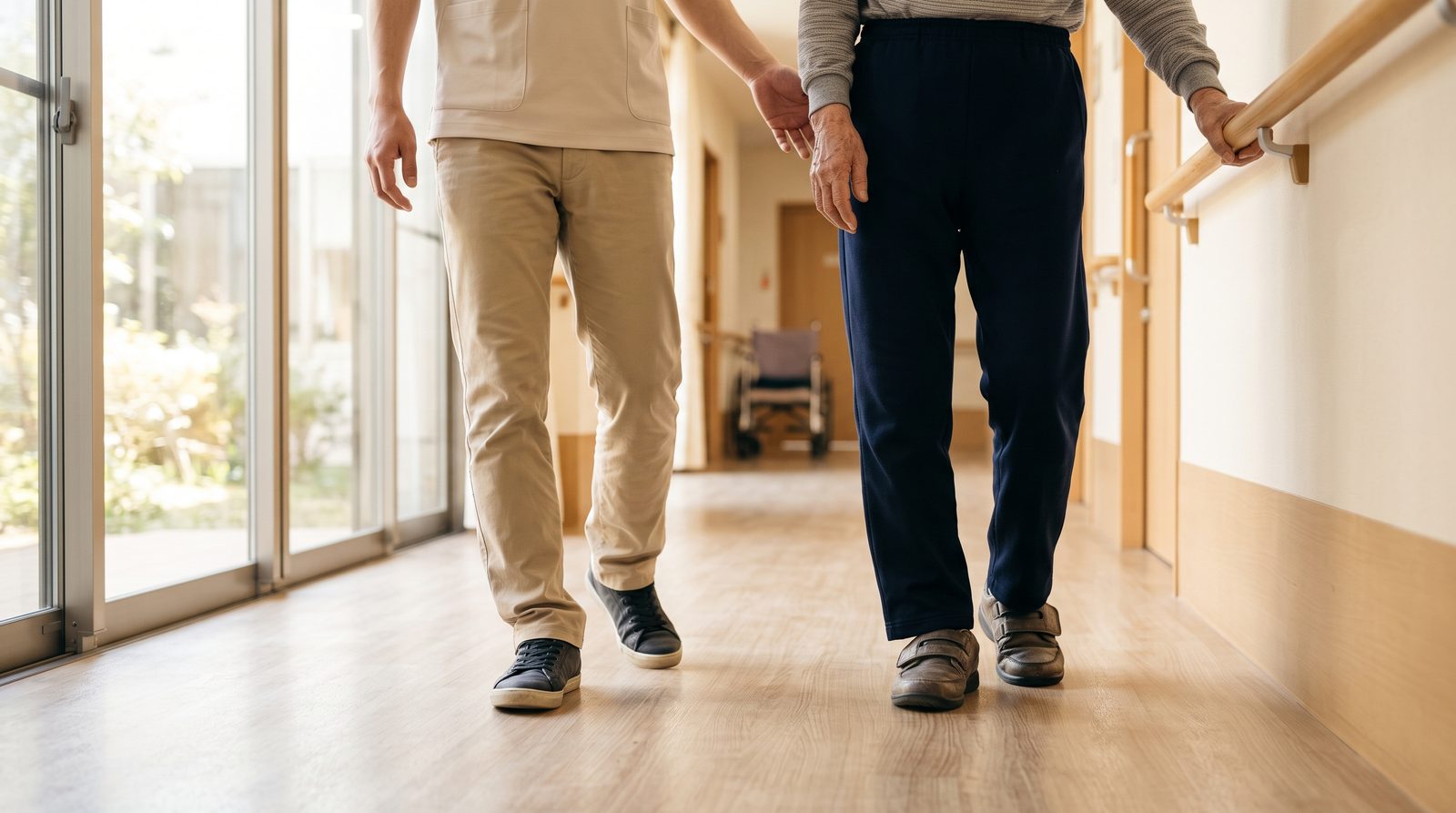
"Getting dressed on their own," "walking to the cafeteria on their own," "using the handrail to stand up in the restroom," and so on,An approach that views everyday activities as rehabilitation in and of themselvesIt is.
Even everyday movements that might not appear to be part of rehabilitation at first glance can serve as effective muscle-strengthening exercises when care staff “deliberately refrain from intervening too much and simply observe.”
What Is Medical Rehabilitation?
For conditions such as aftereffects of a stroke, rehabilitation following a fracture, and joint stiffness caused by chronic conditions,Therapeutic rehabilitation provided on a one-on-one basis by nationally licensed professionals (such as physical therapists)It is.
It can be effective for those aiming to recover from paralysis through intensive, short-term treatment or to regain proper walking form.
3. The Ideal Combination for “Keeping Your Legs and Lower Body Strong”
Not "just one or the other," but,The two rehabilitation programs complement each otheris the most ideal.
For example, during medical rehabilitation, a physical therapist might offer advice on “the best foot positioning and how to grip a handrail when standing up,” and you can then put that advice into practice in your daily life rehabilitation sessions with your care staff. By choosing facilities and services that facilitate this kind of coordination, you can prevent a sudden decline in physical function and regain the confidence that comes from being able to say, “I was able to walk to the bathroom on my own again.”
4. Things to Look for When Choosing a Facility or Touring Services
When your family is looking for services or facilities, consider the following points.
- Are our staff members doing more than what they’re actually supposed to do?(Am I providing too much assistance?)
- Does the facility have physical therapists, occupational therapists, or other professionals on staff, or do they visit and collaborate with the facility on a regular basis?
- Are individual rehabilitation plans (goals) reviewed on a regular basis?
The Taiseikai and Kunikai Group’s “Rehabilitation System Where Welfare and Healthcare Work Hand in Hand”
"I hope they won't just maintain their current condition, but will be able to walk with a little more energy."
"I want my child to receive specialized rehabilitation, but I don't know where to turn for advice."
It is precisely those who think this way who we want to tell about the “Welfare × Medical Care” collaborative rehabilitation program offered by the Daiseikai and Kunikai Group.
At the day care centers, short-stay facilities, and other facilities operated by the Kuni Association, we firmly incorporate the concept of “activity-of-daily-living rehabilitation” into our daily care. Furthermore,Collaboration with the Rehabilitation Department at "Uchida Hospital," which is part of the same groupThe company is doing so.
- A Multidisciplinary Approach by Professionals (PT, OT, ST): Physical therapists and occupational therapists at Uchida Hospital share information with social welfare professionals and provide advice on appropriate exercise programs and assistance methods tailored to each individual’s physical condition.
- Comprehensive support ranging from “post-discharge rehabilitation” to “maintaining daily functioning”: Even after completing a full course of rehabilitation at the hospital, we help you make a smooth transition to Kunikai’s welfare services and support you in maintaining your physical mobility so you can continue living in the community you’re familiar with.
We’re here to provide more than just “basic care”—we’ve created an environment where you can “live a little more energetically than yesterday.” If you have any concerns about rehabilitation or declining physical function, please feel free to contact us.
\ Please feel free to contact us if you have any problems /.
Medical Corporation Daiseikai, Uchida Hospital, Community Healthcare Coordination Office
(TEL) 0278-24-5329
Uchida Home Care Support Office
(TEL) 0278-23-7535
▶ Click here for the Daiseikai Group Uchida Hospital Outpatient Schedule