
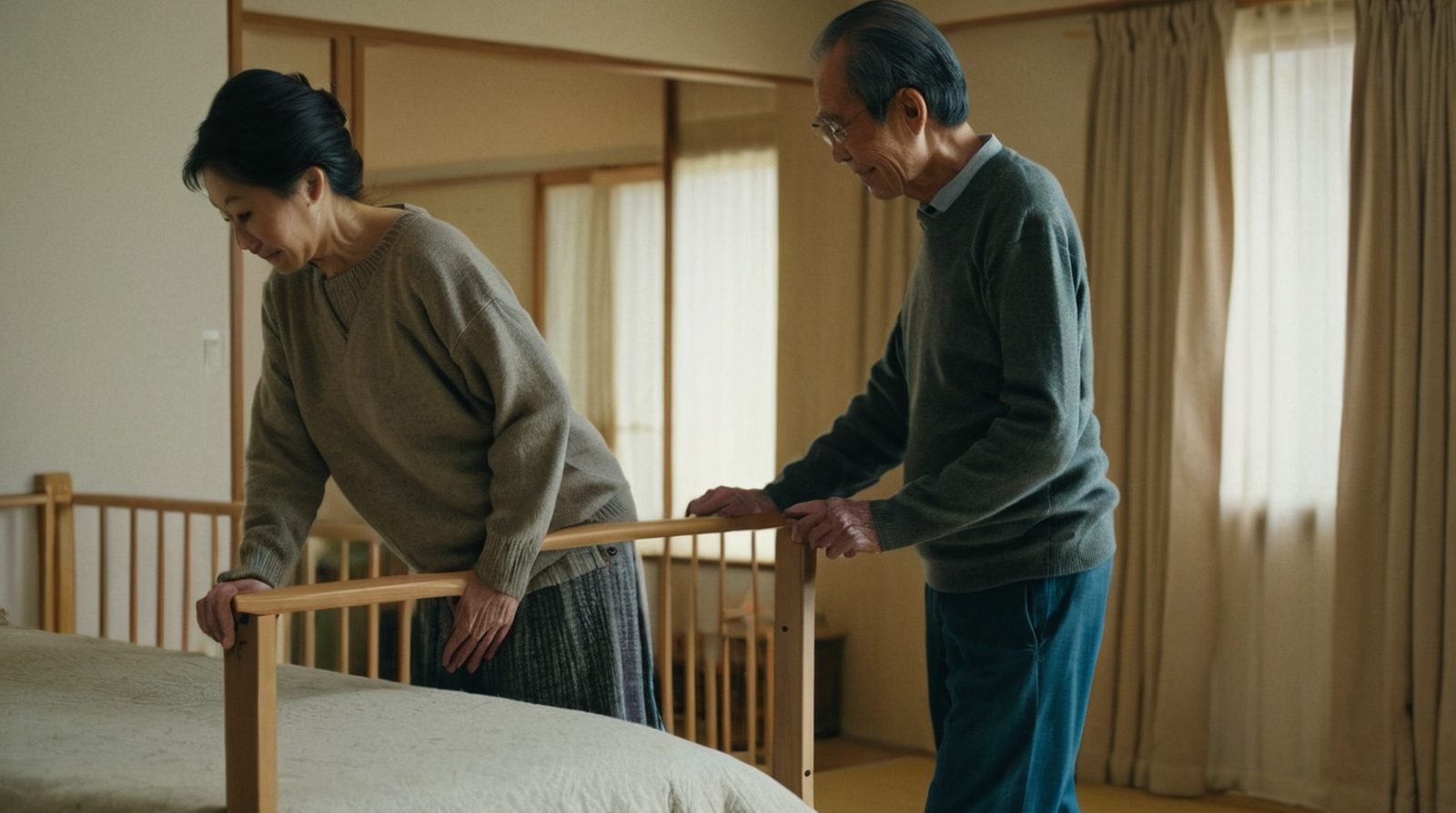
"On a chilly morning, just as I was about to wake my parents up from bed, a sharp, stabbing pain shot through my lower back..."
"Every time I help someone stand up in the bathroom or toilet, I feel my own back and knees nearing their limit."
"If I were to suffer a sudden back injury and couldn't move, who on earth would take care of my parents...?"
From late November, when the mornings and evenings become noticeably colder, through the winter months, family members providing home care are increasingly likely to experience back pain or sudden back spasms.
Forcing yourself to assist someone when your muscles and joints are stiff from the cold can lead to sudden lower back pain or chronic lower back pain."When the caregiver breaks down (both parties breaking down)"is the one thing you want to avoid most when providing home care.
In this article, we’ll explain the basic tips for providing care safely while protecting your own lower back, as well as how to make use of “assistive devices and professional care and rehabilitation services”—resources you should turn to before pushing yourself too hard and causing injury.
1. Why is it easier to strain your lower back when providing care during the winter?
Most cases of lower back pain caused by providing care are,Trying to lift (hoist) an opponent using only your arm and lower back strengthIt stems from...
① “Muscle stiffness” and “stiffness of movement” caused by the cold
When the temperature drops, not only do the caregiver’s lower back and back muscles stiffen, but the parents receiving care also hunch over due to the cold, making it harder for them to move as smoothly as usual. As a result, more strength is required than usual, placing a greater strain on the lower back.
② "Difficulty gripping and tendency to slip" caused by wearing thick clothing
In the winter, because we wear fluffy loungewear and thick socks, our hands tend to slip when we try to steady ourselves, making it easy to twist our lower back when we instinctively brace ourselves.
2. Start Practicing Today! “3 Basic Principles of Assistance” to Protect Your Lower Back
When providing assistance at home, make a point of “sliding, supporting, and utilizing the person’s own strength” rather than “lifting” them.
- Stand with your feet wide apart, one in front of the other, lower your hips, and move closer: Bending forward while keeping your knees straight (the bowing position) puts the most strain on your lower back. Move as close to your parent as possible, lower your center of gravity, and use your knees to bend and straighten your legs.
- "Don't lift it all at once"—break it down into small movements: Instead of trying to sit up suddenly while lying down, shift your weight gradually by first turning onto your side → lowering your legs off the bed → and then using your arms to support yourself as you raise your upper body. This way, you can sit up with minimal effort.
- Incorporating "Assistive Devices" Under Long-Term Care Insurance: "Care beds," which help patients sit up, and "freestanding handrails," which provide support when standing up, can be rented through long-term care insurance. "Sliding sheets" (sheets designed to facilitate movement) are items you purchase and use. Simply using these aids can help reduce the strain on your lower back.
3. “My back hurts, but I just have to put up with it” is a warning sign! When to Seek Professional Help
“I’m just putting on a pain patch to get by,” “I’m wearing a back brace to somehow make it through each day”—if that’s your current situation, you’re already seeing “signs that you’ve reached the limit of providing care at home.”
To protect your lower back and maintain your quality of life, try the following methods to distribute the strain.
- Leave the physically demanding tasks of “bathing, toileting, and mobility” to the professionals: For tasks that are particularly hard on your back—such as assisting with bathing and providing daytime supervision—you should use “day care services” or “in-home care (caregivers)” and leave them to the professionals.
- Maintaining the individual’s “ability to stand up and walk” through rehabilitation: If parents themselves can become even slightly more independent, it will reduce the burden on their caregivers. One approach is to incorporate “outpatient rehabilitation (day care),” “home-visit rehabilitation,” and advanced training programs designed to support walking.
- When you have a sore back or are feeling tired, take a break with a “short stay”: If you’re thinking, “I’d like to rest my body—even if just for a few days—and focus on my treatment,” please take advantage of short-stay services to give yourself time to recover.
The Daiseikai Group supports "your family's health and daily life."
"I've hurt my back, and I'm at a loss as to how I'm going to manage tomorrow's caregiving duties."
"I want to make it just a little easier for my parents to stand up and walk, and reduce the burden on both of us."
In such cases, please consult with us at the Daiseikai-Kunikai Group before you have to put up with it any longer.
- Care That Doesn't Rely on Straining to Lift: At the Daiseikai Group’s day service centers, short-stay facilities, and other facilities, we strive to provide safe care that leverages each individual’s abilities while utilizing assistive devices such as lift baths. We also work with care managers and counselors to develop plans that address situations such as when a family member suddenly experiences lower back pain, as well as to help alleviate the daily burden on families.
- Whether it's the patient's own rehabilitation or a family member's visit to the doctor for lower back pain: In addition to “medical rehabilitation to prevent muscle weakness in parents,” you can also consult with Uchida Hospital (Orthopedics, etc.), which is part of the same group, regarding the examination and treatment of family members who have injured their backs while providing care.
- [Gunma Robo Care Center] Cutting-edge training that helps you never give up on “standing and walking on your own”: Functional improvement training using the wearable HAL® cyborg system helps enhance the individual’s “stability when standing up and walking,” which in turn helps reduce the burden on family caregivers.
Because caregiving is a long-term commitment,"The caregiver's health is the most important thing."So, before your back starts to ache, don't hesitate to seek professional help.
▶ Cutting-Edge Training with the Wearable HAL® Cyborg: Gunma RoboCare Center
▶ Click here for the Uchida Hospital outpatient schedule
\ Please feel free to contact us if you have any problems /.
Medical Corporation Daiseikai, Uchida Hospital, Community Healthcare Coordination Office
(TEL) 0278-24-5329
Uchida Home Care Support Office
(TEL) 0278-23-7535