
Parents are aging,I may need care soon."When you feel that
If you are living away from your own family home, many peoplelong-distance careWe are faced with the reality that
- If something happens, I can't get there right away.
- I can't tell what's going on day to day just by calling.
- Worried about being able to balance work and child rearing
- I don't know how far I should go.
Long-distance caregiving is a caregiving process that is laden with "invisible anxiety" and "difficulty in making decisions" more than it is a physical burden. That is why there are some points you should know before starting.
(1) Decide at the outset that you will not do everything yourself.
The most difficult part of long-distance caregiving is trying to carry the burden all by yourself, even though you live far away from each other.
- Accompanying a patient to the hospital
- Daily monitoring
- Responding to sudden changes
- Procedures at government offices
It is not realistic to assume all of these responsibilities alone. In long-distance care, from the very beginning,The premise is to leverage community support and caregiving services."It is important to think in terms of
(2) Accurately understand the "current living situation".
It is difficult to get a true picture of daily life in just a short period of time when you return home. The following are some points to check.
- Are you eating properly?
- Have you forgotten to take your medication?
- Is there a risk of falling or fire hazard?
- Is there a decrease in the number of words or a darkened facial expression?
If there is a system in place to keep track of these daily activities even when they are far away, the anxiety of long-distance caregiving is greatly reduced.
(3) Establish a "communication route in case of emergency.
The most worrisome aspect of long-distance caregiving is sudden deterioration of health or accidents.
- Neighborhood Collaborators
- family physician (doctor)
- Community Comprehensive Support Center
- care manager
If something goes wrong, who will call, where will they call, and how will they call?"Just by deciding and sharing the following in advance, the mental burden can make a big difference.
4) "Watching over" and "connection" are supplemented by a mechanism.
In long-distance care,Difficult to notice small daily changesThis is a major challenge. This is where the use of tools to watch over seniors is attracting attention.
AI Speaker with Screen "Boisterous! an alternative to
Voysta!" is designed with seniors in mind.AI speaker with screenIt is.
- Easy to operate just by talking to it.
- Large text and easy-to-hear audio
- No difficult settings are required
Happy features for long-distance care
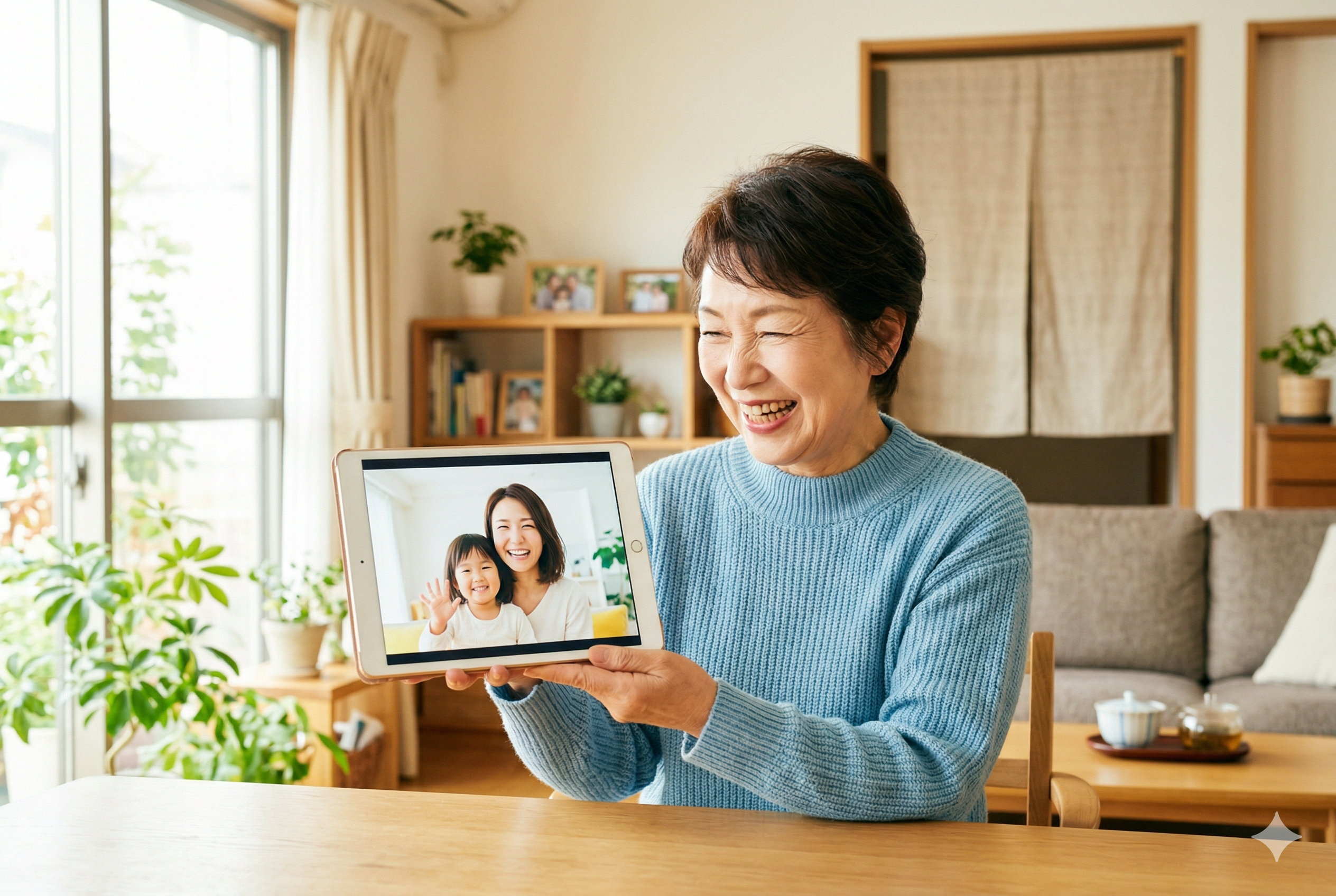
- Family andvideo callcan do (something)
- Sent from my phone.Photos are displayed automaticallyhonorific or passive form of the verb "suru
- The time of your medication and the date of your visit to the hospital.Voice Notification
- Your physical condition and your life.Family members check on linebe made
Not "watchful waiting" as in monitoring,The peace of mind of being connected."The system is easily accepted by older people because it is a system that values the
(5) Consult "before reaching the limit".
Long-distance caregiving can quickly limit your options if you start moving after you reach your limits.
- Discharge is imminent.
- Living alone is in jeopardy.
- The family is exhausted.
Before this happened,Consultation at the stage of "still seems ok but a little uneasyis most important.
Long-distance caregiving is a "team" effort.
Many families who are able to continue long-distance caregiving without difficulty have a good combination of family, community, professionals, and tools.
- Daily monitoring: community members and "boisterous!" and other tools
- Determination of care: Care managers and other professionals
- Family RoleEmotional support and decision-making
Don't try to manage everything yourselves. That is the key to long-distance caregiving.
There are places in the community where you can consult
Every year we receive more and more inquiries from families struggling with long-distance care.
Initiatives in the Taiseikai Group
In addition to providing information on home care, facility use, and short-stay services, the Taiseikai Group offers a wide range of services, including the introduction of monitoring tools.Comprehensive consultation servicesThe company is conducting the following activities.
- What do you need for your life now?
- How can I continue to live at home?
- How to combine watch and care services
Even if you are at the stage of "not sure if you want to use our services yet," we can consult with you from the situation planning stage.
Summary: You don't have to be alone, even if you're long distance.
The burden of long-distance caregiving is more than the physical distance itself,"To be alone with your fears."It is located at
- Think on the assumption that you can rely on them.
- Visualize" the situation
- Incorporate mechanisms to stay connected
- Consult with a professional organization as soon as possible.
By being aware of these, long-distance caregiving can be"A form that is easy to follow."The result can be transformed into a
When in doubt, please contact us first. We will then work with you to find the most reasonable method for your family.
\ Please feel free to contact us if you have any problems /.
Medical Corporation Taiseikai Uchida Hospital Community Medical Cooperation Office
(TEL) 0278-24-5329
Uchida Home Care Office
(TEL) 0278-23-7535